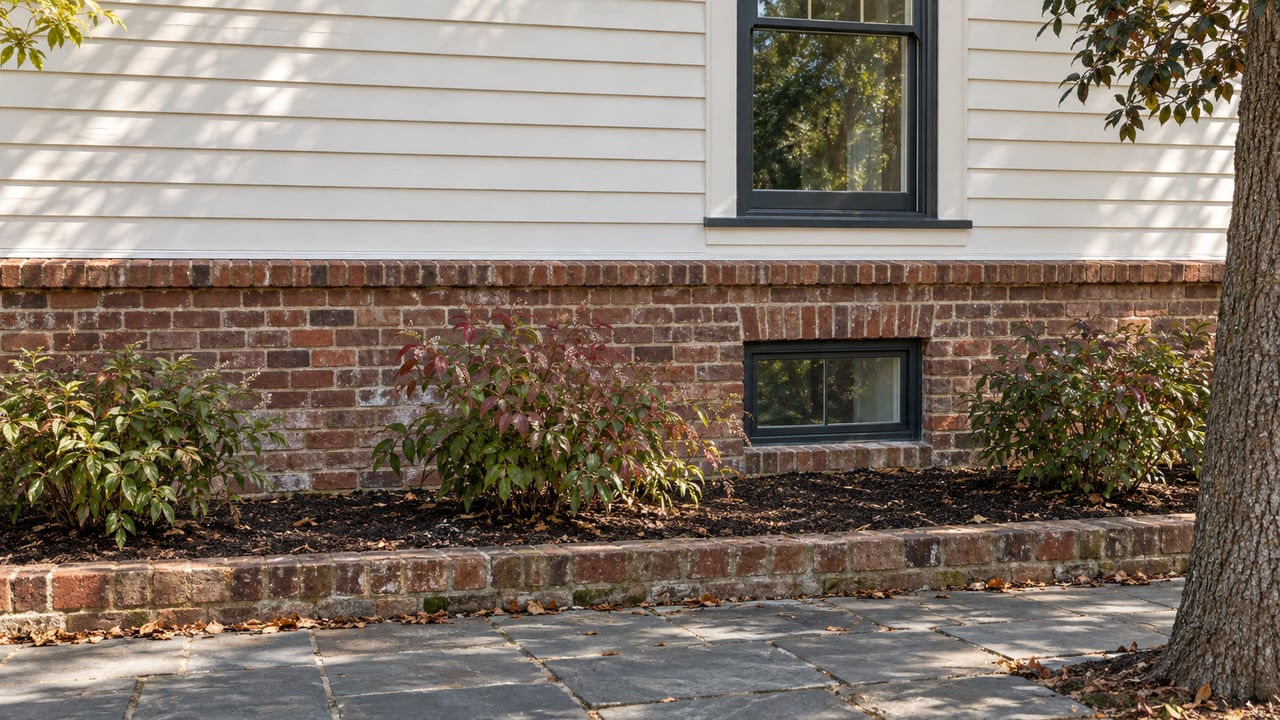
Why Sewer Scopes Matter for Older Old Fourth Ward Homes
October 1, 2026
October 1, 2026
Ten days into due diligence on an Old Fourth Ward bungalow, the inspection report usually lands in the buyer's inbox looking thorough. Roof, electrical panel, HVAC age, crawl space moisture, every visible system gets a page. Then there's a line near the plumbing section, often in boilerplate language, that says something like "sewer lateral not evaluated as part of this inspection, camera scope recommended." Most buyers read past it. The report looks clean. The house looks fine. Nobody circles back.
That line is doing more work than it appears to. In Old Fourth Ward specifically, it's pointing at the one component of the house most statistically likely to be near the end of its service life, and the one component the City of Atlanta does not require anyone to inspect before the sale closes, according to ATL311.
A general home inspection is a visual, non-invasive walkthrough. It checks what an inspector can see, reach, or test from inside the structure and around its exterior. The pipe that carries wastewater from the house to the city main runs underground, often four to six feet deep, and a standard inspector has no tool for looking at it. Finding out what condition that pipe is in requires a separate, optional add-on: a sewer scope, where a camera on a cable is fed through a cleanout or drain access point to record the interior of the line.
Buyers and their inspectors often treat this as a nice-to-have for older homes. In Old Fourth Ward, the math suggests it belongs in the same category as the roof and the panel, not as an afterthought.
Old Fourth Ward is one of the oldest developed sections of Atlanta, with Victorian homes and Craftsman bungalows built in the early 1900s and the largest concentration of surviving single-family houses sitting south of Freedom Parkway, especially around Irwin Street. Those homes were plumbed with whatever was standard at the time, which for most of the twentieth century meant clay tile or cast iron.
A Columbus News Online report on an NGI Trenchless Pipe & Sewer Repair analysis of metro Atlanta pipe conditions, released in August 2026, put a number on how long those materials last: roughly 50 to 60 years for clay, 50 to 75 for cast iron. By that measure, a line installed in 1980 is approaching the end of its expected service life. A line installed in 1910, in a house that predates the automobile becoming common in Atlanta, has been underground for well over a century.
Two regional conditions make the countdown faster here than in newer suburbs. Georgia's red clay soil expands when wet and contracts when dry, and that repeated movement, which local contractors call the "red clay squeeze," cracks rigid joints in clay and cast-iron pipe over time. Once a joint cracks, tree roots looking for moisture move in through it, and the same analysis notes that roots from trees within 30 feet of a line are the leading cause of recurring backups. Old Fourth Ward has both ingredients: century-old infrastructure and mature tree canopy along streets like Boulevard and around Historic Fourth Ward Park.
Some cities have decided this risk is too common to leave to chance and built a check into the sale itself. A property owner in these places can't close without a documented look at the line:
| City | What triggers the requirement |
|---|---|
| Oakland, CA | According to CaliChi, a sewer lateral compliance certificate is required at property transfer |
| Berkeley, CA | Lateral replacement with backwater valve required if original cast iron or clay |
| Portland, OR | Sewer scope required at sale in basins with documented inflow and infiltration problems |
| Arcata, CA | The City of Arcata requires inspection for buildings over 25 years old at time of sale |
Atlanta has no equivalent ordinance. The city's public guidance on sewer connections, published through ATL311, covers permitting for new lateral connections and points sellers to the Department of Watershed Management for GIS maps of existing lines, but it does not require a compliance certificate, a camera inspection, or any pass-fail check before a home changes hands. According to Atlanta Plumbing Authority, the point where the city's responsibility ends and the homeowner's begins is simply the property line, and maintenance of everything on the homeowner's side of that line has always been the homeowner's job, checked or not.
Georgia compounds the gap rather than closing it. The state follows a caveat emptor doctrine, meaning sellers are not statutorily required to complete a disclosure form at all, according to a legal summary published by Nolo. Most transactions still use the Georgia Association of REALTORS Seller's Property Disclosure Statement as a matter of practice, but that form's plumbing section asks only whether the sewer system is public, private, or septic. It does not ask about pipe material, installation date, or the results of any camera inspection, because none of those things are required to have happened.
Georgia case law does draw one line. In Wilhite v. Mays, a 1976 decision still cited in current disclosure guidance, a court found a seller liable for concealing a sewer system defect the seller actually knew about and that a buyer couldn't discover through ordinary inspection. The exposure only exists if the seller had specific knowledge and stayed quiet. A seller who genuinely never had the line scoped has nothing to conceal, because there's nothing on record to know.
The practical result is that a truthful, complete Georgia disclosure form on a 1910 Old Fourth Ward house can say "no known issues" and still describe a corroding clay pipe accurately, simply because no one on either side of the transaction has looked.
The reason this is worth a few hundred dollars of due diligence rather than a shrug comes down to what a failure costs. The same Columbus News Online report put traditional dig-and-replace repair on an aging clay or cast-iron line at $5,000 to $12,000, with costs exceeding $25,000 on deep or hard-to-access lines, a range consistent with the kind of century-old, tree-lined lot common south of Freedom Parkway.
The upside is that a failed line doesn't automatically mean a torn-up yard. Trenchless repair, known as cured-in-place pipe or CIPP, inserts a resin-saturated liner into the existing pipe and cures it in place, sealing cracks and root intrusion points without excavation. NGI's analysis describes the process as typically restoring a residential line in about a day, with a rehabilitated pipe good for up to another 50 years. For a seller who gets a bad scope result mid-contract, that's a repair that can often be scheduled and finished before a closing date needs to move, rather than a project that stalls the deal for weeks.
Old Fourth Ward isn't uniform, and that's part of what makes a blanket assumption risky. The neighborhood's single-family stock, concentrated south of Freedom Parkway around streets like Irwin, sits alongside 2010s multifamily construction such as BOHO4W and AMLI Ponce Park built closer to Historic Fourth Ward Park. A house built during that later wave was very likely plumbed in modern PVC, which doesn't carry the same clay-and-cast-iron exposure. Age, not just location, is the variable that matters. Two houses three blocks apart can carry completely different lateral risk depending on when each one was actually built, which is a detail worth confirming against the property's actual permit and construction records rather than assuming from the block.
Is a sewer scope required by law before selling a home in Atlanta? No. Georgia does not require a seller disclosure form by statute, and the City of Atlanta has no point-of-sale sewer lateral ordinance comparable to cities like Oakland or Portland.
Who owns the sewer lateral, the homeowner or the city? The property line is generally the point of demarcation. Everything from the house to that line is the homeowner's responsibility to maintain and repair.
If you're weighing a century-old bungalow against newer construction in Old Fourth Ward, or trying to figure out what a clean disclosure form actually does and doesn't tell you, Roxanne Sellers can walk through what to ask before you write the offer. Let's Connect — Schedule a Consultation.
This article is general information, not legal, tax or financial advice. Consult a qualified professional about your situation.




Roxanne’s clients enjoy her personal touches, and it is truly her joy to ultimately fulfill her client’s requests throughout the transaction and graciously serve them.With only her clients’ best interests in mind, she acts as a skilled advocate on their behalf.